Smarter Layouts. Less Waste.
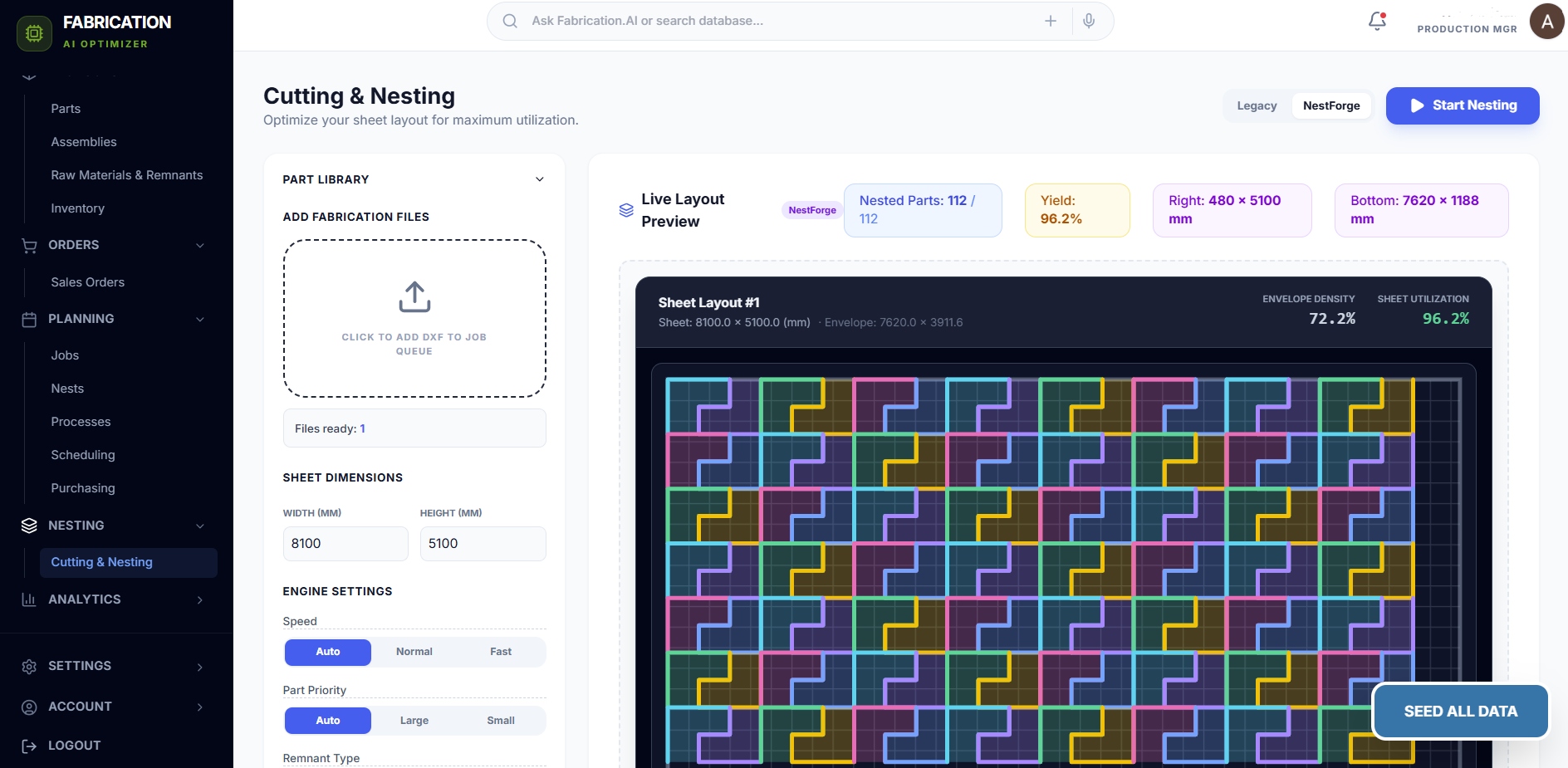
Fabricator-AI's nesting engine uses trained machine learning models — not just geometry heuristics — to achieve material utilization rates that traditional algorithms can't match.
What Is Sheet Nesting?
Nesting is the process of arranging parts on a flat sheet of raw material to maximize usage and minimize waste. Every square inch left unused is money in the scrap bin.
It sounds simple. It isn't. Sheet nesting is classified as an NP-hard computational problem — meaning there is no single "perfect" solution, only increasingly better ones. When you factor in irregular shapes, kerf compensation, grain direction, mixed part sizes, and multi-sheet batching, the complexity explodes far beyond what any human can solve manually.
The metric that matters is material utilization — the percentage of usable part area versus total sheet area. Even a 3–5% improvement in utilization can save a mid-size fabrication shop hundreds of thousands of dollars per year.
Not All Nesting Is Created Equal
Nesting algorithms range from basic rectangular packing to AI-trained optimization. The differences in material yield are significant — and they compound with every sheet you cut.
Guillotine Nesting
Relies on straight, edge-to-edge cuts only. Fast and predictable, but the linear constraint leaves significant unused material between parts.
Rectangular Nesting
Wraps each part in a bounding rectangle, then packs rectangles. Simple input (just width and length), but ignores the actual part geometry — wasting the gaps around irregular shapes.
True-Shape (NFP)
Uses No-Fit Polygons to respect actual part geometry. Parts interlock tightly — including filling holes with smaller pieces. A major step up, but still rule-based.
Heuristic & Genetic
Evaluates thousands of candidate layouts and iteratively improves them through simulated natural selection. Good for mixed-part jobs, but each optimization starts from scratch.
AI-Trained Nesting
Machine learning models trained on real production data — not just geometric heuristics. The system learns from every job: which rotations work best for specific material types, how kerf behaves on different machines, which part combinations interlock most efficiently. It doesn't start from zero. It starts from experience.
Why Trained AI Outperforms Traditional Algorithms
Traditional nesting algorithms — even advanced heuristics — treat every job as a fresh puzzle. They have no memory of what worked before.
Fabricator-AI's nesting engine is different. Our machine learning models are trained on thousands of real production jobs. They learn patterns that no rule-based system can encode:
- Material memory — the system knows how different materials (steel, aluminum, foam, glass) respond to different nesting strategies
- Machine-specific optimization — nesting adapts to your specific CNC machines, their kerf widths, cutting speeds, and constraints
- Job-mix intelligence — the AI combines parts from different orders to fill sheets more efficiently than single-order nesting
- Continuous improvement — unlike static algorithms, the model gets better with every production run
From Upload to Optimized Cut File
Four steps. Seconds, not hours. And the AI gets smarter with every run.
Import Parts
Upload DXF/DWG files, pull from your CAD system, or enter dimensions directly. The engine automatically detects geometry, material type, and grain direction requirements.
AI Optimization
The trained model evaluates thousands of layout candidates in seconds — factoring in part rotation, mirroring, common-line opportunities, kerf compensation, and remnant reuse. It draws on learned patterns from prior jobs to find solutions fast.
Review & Adjust
See the proposed layout with real-time utilization metrics. Override placements if needed, lock priority parts, or run alternative strategies to compare yields side by side.
Cut & Learn
Export optimized cut files directly to your CNC machines. After production, actual results feed back into the model — reinforcing what worked and refining future nests.
The Numbers Speak
Fabricator-AI customers see measurable improvements from day one — and the gains accelerate as the AI learns your specific production patterns.
Every Offcut Is an Opportunity
After every nest, the system automatically tracks remnants — the usable offcuts left on each sheet. Every remnant is cataloged with its exact dimensions, material type, and location in your inventory.
Most shops lose track of remnants. They stack up in a corner, get forgotten, and eventually get scrapped. With Fabricator-AI, every remnant becomes a first-class raw material that the system actively looks to use.
- Use remnants in regular production — the nesting engine treats tracked remnants as available raw material and will automatically include them in future nests alongside full sheets
- Force remnant-only nests — when you want to burn through your remnant pile, lock the nesting engine to remnant stock only and watch it find the best layouts from what you already have on the floor
- Automatic remnant detection — after every nesting job, remnant dimensions are calculated and stored automatically — no manual measuring, no guesswork
- Remnant-aware optimization — the AI considers remnant shapes and sizes when planning nests, preferring remnants over new stock when utilization is comparable — reducing both waste and material cost
See AI Nesting in Action
Upload your parts. Watch the AI optimize. Compare the results against your current nesting software.
Schedule Demo